
A starter battery, commonly classified as an SLI (Starting, Lighting, and Ignition) battery, is an electrochemical storage device engineered specifically to deliver high-amperage electrical surges for brief durations (typically 1 to 5 seconds) to crank and start an internal combustion engine.
Unlike deep-cycle batteries that provide steady, low-current power over hours, a starter battery prioritizes peak instantaneous current output to overcome static engine friction before immediately handing over electrical supply responsibilities to the vehicle’s alternator.
Starter Battery vs. Deep-Cycle Battery: Technical Comparison
The mechanical, chemical, and structural differences between starter and deep-cycle batteries dictate their operating limits and intended applications.
| Feature / Metric | Starter (SLI) Battery | Deep-Cycle Battery | Dual-Purpose Battery |
| Primary Objective | Maximize instantaneous cranking current (CCA) | Provide continuous, low-draw energy over extended periods | Balance high initial cranking with moderate cycling durability |
| Internal Plate Architecture | Many thin, highly porous lead plates for maximum surface area | Fewer, thick, solid lead plates designed to resist structural erosion | Medium-thickness plates engineered for hybrid duty cycles |
| Grid Alloy & Chemistry | Lead-Calcium alloys optimized for low internal resistance (R₁) | Antimony or heavy lead-antimony grids for repeated deep cycles | Hybrid lead-calcium/antimony grid formulation |
| Maximum Discharge Depth (DoD) | 10%-15% maximum per cycle | 50%-80% maximum per cycle | 30%-50% maximum per cycle |
| Peak Current Output | Extremely High (300A -1000A+) | Low to Moderate (50A -200A) | Moderate to High (400A 750A) |
| Sensitivity to Deep Discharge | High (Severe plate damage below 50% SoC) | Low (Engineered for repetitive deep draining) | Moderate |
| Primary Applications | Passenger Cars, Motorcycles, Marine Engine Start | Golf Carts, RV House Power, Off-Grid Solar, Trolling Motors | Marine Vessels, Emergency Service Vehicles |
How Starter Batteries Deliver High Cranking Power
To crank a cold engine, the starter motor requires an immediate surge of energy to overcome mechanical resistance, oil viscosity, and cylinder compression.
Surface Area and Low Internal Resistance
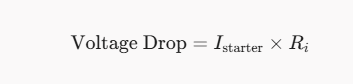
Starter batteries utilize a large number of extremely thin lead plates per cell. By maximizing plate surface area, the internal resistance (R) of the battery is reduced to milliohm levels. According to Ohm’s Law (V = I R₁), lower internal resistance minimizes internal voltage drop during high-current draws (300A-800A+):
The Electrochemical Burst
When the ignition completes the starter circuit, the active materials- lead dioxide (PbO2) on the positive plate and Sponge Lead (Pb) on the negative plate-react instantly with the sulfuric acid (H2SO4) electrolyte:

Because the plate surface area is vast, millions of chemical reactions occur simultaneously across microporous channels, releasing free electrons across the terminals almost instantaneously.
Cold Cranking Amps (CCA)
Cold ambient temperatures increase engine oil viscosity while simultaneously slowing down internal chemical activity. To quantify starting reliability, starter batteries are rated in Cold Cranking Amps (CCA): the number of amperes a battery can deliver at -18°C (0°F) for 30 seconds while maintaining terminal voltage above 7.2V.
Starter Batteries in Modern Vehicle Systems
Start-Stop Vehicles & Advanced Battery Technologies
Standard flooded SLI batteries cannot handle the frequent cycling required by modern Start-Stop systems, which may restart the engine dozens of times during a single commute.
- Enhanced Flooded Battery (EFB): Integrates a polyester scrim layer on the positive plate surface and carbon additives in the negative paste to increase charge acceptance and cycle life over standard flooded batteries.
- Absorbent Glass Mat (AGM): Contains the electrolyte suspended entirely within microporous fiberglass mat separators. AGM batteries offer lower internal resistance, faster dynamic charge acceptance (DCA), 3x the cycle life of standard flooded batteries, and superior tolerance for rapid micro-cycling in Start-Stop systems.
Dual-Battery Architecture in Luxury and Commercial Vehicles
Many modern luxury vehicles, heavy commercial trucks, and marine vessels use two distinct batteries:
- Primary Starter Battery: Dedicated exclusively to cranking the engine and supporting primary control modules.
- Auxiliary Battery: Powers high-draw comfort accessories, active suspension systems, driver-assist sensors, and parking electronics, protecting the primary starter battery from parasitic discharge.
Why Starter Batteries Fail Under Deep Discharge
Starter batteries are intentionally designed for short-duration energy release, not sustained load support with the engine off.
- Shedding Active Material: Because starter plates are thin and delicate, deep discharge cycles cause heavy physical expansion and contraction of the lead paste. This causes the active material to flake off the grid frame and drop to the cell bottom, permanently losing capacity.
- Irreversible Hard Sulfation: Leaving a starter battery below 50% State of Charge (<12.2V) causes fine, amorphous lead sulfate (PbSO4) crystals to recrystallize into large, non-conductive structures. These hard sulfate crystals block electrolyte flow and cannot be broken down during normal alternator charging.
Diagnostic Signs of Starter Battery Failure
Recognizing early indicators of starter battery degradation prevents unexpected vehicle lockouts:
- Slow Engine Crank: The starter motor turns over slowly or sounds strained during ignition.
- Cranking Voltage Collapse: Terminal voltage drops below 9.6V during a standard 15-second starter engagement test at room temperature.
- Solenoid Click: The starter solenoid clicks rapidly because terminal voltage collapses instantly under high current draw.
- Dimming Dashboard & Headlights: Headlights or interior lights dim significantly prior to engine start, then brighten immediately once the alternator powers the vehicle.
- Automatic Start-Stop Disablement: The ECU automatically disables auto-stop capability because measured State of Health (SoH) or State of Charge (SoC) drops below safety thresholds.
FAQs
Can a starter battery be used as a deep-cycle battery for camping or RV appliances?
No. Using a starter battery to power continuous, low-draw appliances causes deep discharges that degrade its thin lead plates. A starter battery subjected to repeated deep cycles can lose up to 80% of its usable capacity within a few dozen discharge cycles.
What happens if you install the wrong battery type in a Start-Stop vehicle?
Installing a standard flooded starter battery in a vehicle designed for an AGM or EFB battery leads to rapid battery degradation (often within 3 to 6 months). Standard batteries cannot absorb high charge currents from regenerative braking or handle the continuous micro-cycling demanded by Start-Stop systems.
What is the difference between a car starter battery and a marine battery?
Automotive car batteries are pure starter batteries built for high CCA surges in stable conditions. Marine batteries are usually dual-purpose or deep-cycle, featuring thicker internal plates and reinforced cell construction to handle marine engine starting, wave vibration, and sustained trolling motor loads.
Why is correct battery selection critical for engine starters?
Matching the manufacturer’s specified CCA, Ampere-hour (Ah) rating, and chemistry type (Flooded, EFB, or AGM) ensures the starter motor receives sufficient cranking current under extreme temperatures without overstressing the charging system or triggering low-voltage diagnostic codes in modern vehicle control units.